AI Hiring in 2026: Why Your Resume Isn't Enough
For years, the resume was the centre of the job application.
You wrote down your education, skills, internships, projects, and experience. You sent it to a company, hoped an applicant tracking system would accept it, and waited for a recruiter to call.
That model is changing.
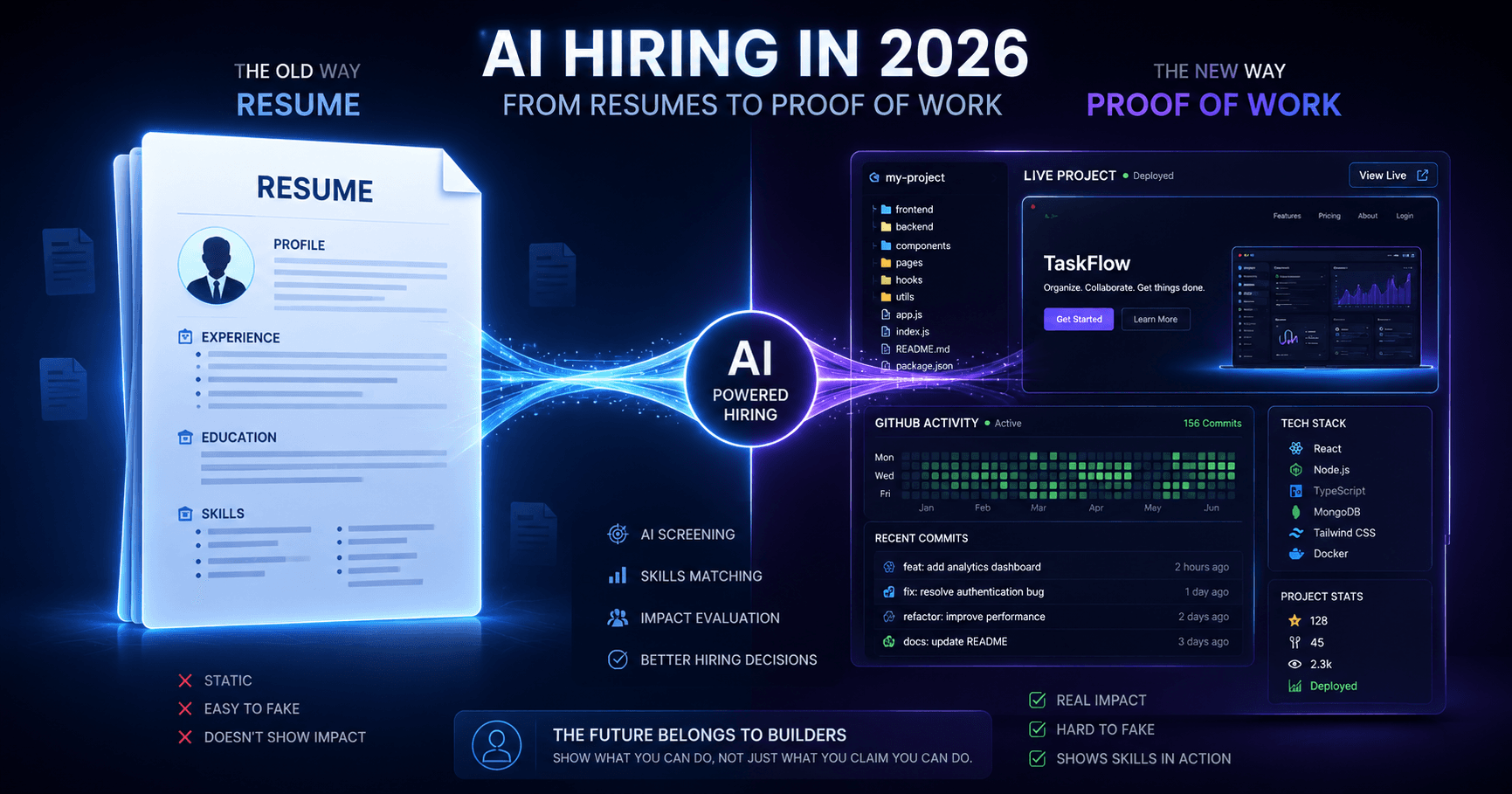
The resume is not dead. But in 2026, it is increasingly becoming one signal among many.
AI is changing how recruiters find candidates, how applications are screened, and how companies think about skills. At the same time, AI has made it dramatically easier for candidates to generate polished resumes and apply to large numbers of jobs.
That creates a new problem:
When everyone can make their application look good, how do employers figure out who can actually do the work?
The answer is increasingly moving toward skills, assessments, experience, and evidence of ability.
This article explains what is happening, why it matters, and what students and job seekers can do about it.
The hiring process is changing
The old mental model looked roughly like this:
Resume
   ↓
Recruiter review
   ↓
Interview
   ↓
Offer
The modern process can involve many more signals:
Application
   ↓
ATS / automated screening
   ↓
Skills & experience matching
   ↓
Assessment
   ↓
Interview / AI-assisted screening
   ↓
Human evaluation
   ↓
Offer
The exact process varies by company and role, but the direction is clear: employers are looking for ways to evaluate candidates at scale without relying exclusively on a document.
LinkedIn's 2026 research found that 93% of recruiters planned to increase their use of AI in 2026, while 59% said AI was already helping them discover candidates with skills they otherwise would not have found. Two-thirds of recruiters also said they planned to increase AI use for pre-screening interviews. [1]
That does not mean every company is replacing recruiters with AI.
It means AI is becoming part of the hiring infrastructure.
AI has created a strange problem for hiring
Generative AI has made it easier than ever to produce a polished application.
A candidate can use AI to:
- Rewrite a resume
- Generate a cover letter
- Tailor an application to a job description
- Prepare interview answers
- Practice technical questions
- Research a company
- Apply to more jobs in less time
That sounds great for candidates.
But the same technology is available to almost everyone.
If 500 applicants can produce a highly polished resume in minutes, the visual quality of the resume becomes a weaker differentiator.
The result is a growing gap between presentation and proof.
A resume can tell an employer:
"I know Python."
A project can show:
"I used Python to build this system."
A deployed project can go one step further:
"Here is the system. You can use it."
That difference matters.
The rise of skills-based hiring
One of the biggest shifts happening underneath modern recruitment is the move toward skills-based hiring.
Instead of asking only:
Where did this person study?
or:
Where did this person work?
companies increasingly want to know:
What can this person actually do?
LinkedIn's Future of Recruiting research found that more than nine out of ten talent-acquisition professionals believe accurately assessing candidate skills is important for improving quality of hire. LinkedIn also reported that companies with the most skills-based searches were 12% more likely to make a quality hire. [2]
This does not mean degrees or previous employers suddenly have no value.
They are still signals.
But they are increasingly being supplemented by evidence of capability.
For students, this is particularly important.
You may not have five years of experience.
You may not have worked at a famous company.
But you can still build evidence that you know what you are doing.
What counts as evidence?
For a software engineer, evidence can include:
1. Real projects
Don't just list:
MERN Stack
Show the application you built.
Explain the problem.
Explain the architecture.
Show what you implemented.
Explain the trade-offs.
2. GitHub
A GitHub profile can show more than a resume bullet.
It can demonstrate:
- Code quality
- Project structure
- Documentation
- Commit history
- Technical depth
- Ability to work with real tools
A GitHub profile isn't automatically impressive, though.
Ten unfinished tutorial repositories are weaker evidence than one well-built, documented project.
3. Deployment
A deployed project changes the conversation.
Instead of saying:
"I built a job portal."
you can say:
"I built a job portal, deployed it, and here is the live application."
Shipping is evidence.
4. Technical writing
Writing about what you build can demonstrate whether you actually understand it.
Explain:
- Why you chose a technology
- What problem it solved
- What went wrong
- How you fixed it
- What you would change in version two
This is especially valuable for complex areas such as AI engineering and system design.
5. Open source
Contributing to an existing project demonstrates that you can work inside someone else's codebase.
That is very different from building everything in isolation.
6. Technical assessments
As skills-based hiring grows, expect practical evaluation to remain important.
For software roles, that can mean:
- Coding assessments
- System design
- Take-home projects
- Debugging exercises
- AI engineering tasks
- Technical interviews
The exact format changes, but the underlying question is the same:
Can you actually perform the work?
So should you stop caring about your resume?
No.
That would be the wrong conclusion.
Your resume is still useful because recruiters need a fast way to understand your background.
The mistake is treating the resume as the entire product.
Think of it this way:
Your resume should be the index, not the entire book.
The resume gets someone interested.
Your projects, GitHub, portfolio, writing, experience, and technical performance provide the evidence behind the claims.
A strong application might therefore look like:
Resume
  ↓
Clear skills + experience
  ↓
Portfolio / GitHub
  ↓
Real projects
  ↓
Deployment / measurable results
  ↓
Technical assessment
  ↓
Interview
What students should do differently in 2026
If you are a student, this shift can actually work in your favour.
You cannot immediately manufacture five years of professional experience.
But you can build proof of skill.
Instead of spending six months trying to make your resume look perfect, spend some of that time making the underlying profile stronger.
Build 2–4 serious projects
Not 15 tutorial projects.
Build things that solve actual problems.
For example:
- An AI-powered application
- A production-style backend
- A data pipeline
- A search system
- A SaaS product
- An automation tool
- An open-source contribution
Deploy them
A project sitting in a folder is difficult to evaluate.
A working product is much easier to understand.
Document them
Write a good README.
Explain the architecture.
Show screenshots.
Include setup instructions.
Explain technical decisions.
Build a public technical presence
You don't need to become an influencer.
But publishing what you learn can make your expertise discoverable.
Write about:
- Things you built
- Problems you solved
- Technical concepts you understand
- Mistakes you made
- Lessons from projects
Stop collecting technologies
A resume with:
Python | Java | C++ | JavaScript | React | Node | AWS | Docker | Kubernetes | ML | AI | SQL | MongoDB | Redis | ...
does not automatically demonstrate competence.
A smaller set of technologies backed by serious projects is often more convincing.
The goal isn't to look skilled.
The goal is to become easy to verify.
AI will not make hiring purely automated
There is another important point.
It is tempting to look at AI hiring and assume:
"Recruiters won't matter anymore."
That is unlikely to be the whole story.
Hiring involves judgment.
Companies need to evaluate communication, collaboration, problem-solving, motivation, judgment, and role fit.
Indeed's research on skills-first hiring makes a similar point: AI can help employers analyse applications and identify skills at scale, but human judgment remains important in hiring. [3]
The more realistic future is probably AI-assisted hiring, not completely human-free hiring.
AI handles more of the repetitive work.
Humans spend more time evaluating the candidates who make it through.
That makes the quality of the signals candidates provide even more important.
The new problem: proving that your work is real
There is another consequence of generative AI that doesn't get enough attention.
AI can help someone build a polished-looking resume.
It can also help someone generate code.
It can help write project documentation.
It can help answer interview questions.
So employers face a new question:
How much of what I'm seeing represents the candidate's actual ability?
This is why proof-of-work becomes increasingly valuable.
If you claim you built something, be prepared to explain:
- Why you built it
- How it works
- Why you chose the architecture
- What failed
- How you debugged it
- What you would improve
- What trade-offs you made
You don't need to build everything without AI.
You need to understand what you built.
The biggest mistake job seekers can make
The biggest mistake isn't using AI.
It is using AI to make a weak profile look stronger instead of using AI to become stronger.
There is a huge difference.
Bad use:
"Make my resume sound impressive."
Better use:
"Analyze this job description and tell me which skills I am missing."
Even better:
"Help me create a project that demonstrates those skills."
The first improves presentation.
The second improves capability.
The third creates evidence.
That is the direction I would optimize for.
A practical strategy for 2026
If I were starting from zero today, I would build my career profile around five layers.
Layer 1 — Fundamentals
Learn the skills required for the role you want.
For software engineering, that might include:
- Data structures and algorithms
- Programming
- Databases
- Networking
- Operating systems
- System design
For AI engineering, add:
- Machine learning fundamentals
- LLMs
- Embeddings
- RAG
- Evaluation
- AI application architecture
Layer 2 — Projects
Build projects that demonstrate those skills.
Layer 3 — Proof
Deploy them.
Document them.
Put the code somewhere public when appropriate.
Measure results when possible.
Layer 4 — Visibility
Make your work discoverable.
Your LinkedIn profile, GitHub, portfolio, technical writing, and open-source contributions can all contribute.
Layer 5 — Resume
Finally, compress everything into a resume that makes the strongest evidence easy to find.
This reverses the traditional mindset.
Instead of:
Resume → try to prove yourself
think:
Build skills → create proof → make proof discoverable → use resume to connect the dots
The resume isn't disappearing. Its job is changing.
The resume still has a purpose.
It gives recruiters context.
It helps applications move through systems.
It summarizes experience.
But it is becoming harder for a two-page document to carry the entire burden of proving someone's ability.
The more AI makes applications easier to generate, the more valuable credible evidence becomes.
That is why I don't think the future of hiring is:
Resume vs. AI
I think it is:
Claims vs. evidence.
A resume makes claims.
A project provides evidence.
A GitHub repository provides evidence.
A deployed application provides evidence.
An assessment provides evidence.
An interview provides evidence.
And the candidates who learn how to create and communicate that evidence will have an advantage.
What this means for you
If you're a student or early-career professional, don't panic because AI is changing hiring.
Use the change to your advantage.
Don't spend all your time trying to make your resume look like someone with ten years of experience.
Build something.
Ship something.
Break something.
Fix it.
Write about it.
Put it where people can see it.
Then make your resume point toward it.
Your resume shouldn't be the proof that you're capable.
It should be the map that helps employers find the proof.
Sources
-
LinkedIn, Talent 2026: Nearly 80% of people feel unprepared to find a job in 2026.
https://news.linkedin.com/2026/LinkedIn-Research-Talent-2026 -
LinkedIn, The Future of Recruiting 2025.
https://business.linkedin.com/hire/resources/future-of-recruiting -
Indeed, AI Has the Power to Unlock Skills-First Hiring.
https://in.indeed.com/insights/ai-has-the-power-to-unlock-skills-first-hiring -
Indeed, Smarter Hiring with Data-Driven Insights: Quality & Skills Edition — India.
https://in.indeed.com/insights/smarter-hiring-with-data-driven-insights-quality-skills-edition
Suggested SEO metadata
Primary keyword: AI hiring in 2026
Secondary keywords:
- AI recruitment
- hiring trends 2026
- future of hiring
- resume in 2026
- AI resume screening
- ATS
- skills-based hiring
- how to get hired in 2026
- job search in 2026
- proof of work
Suggested social title:
Your Resume Isn't Enough Anymore: How AI Is Changing Hiring
Suggested excerpt:
AI is changing how companies find, screen, and evaluate candidates. Here's what is actually changing in hiring in 2026—and what students and job seekers can do to stand out.
Suggested URL:
/blog/ai-hiring-2026-why-your-resume-isnt-enough