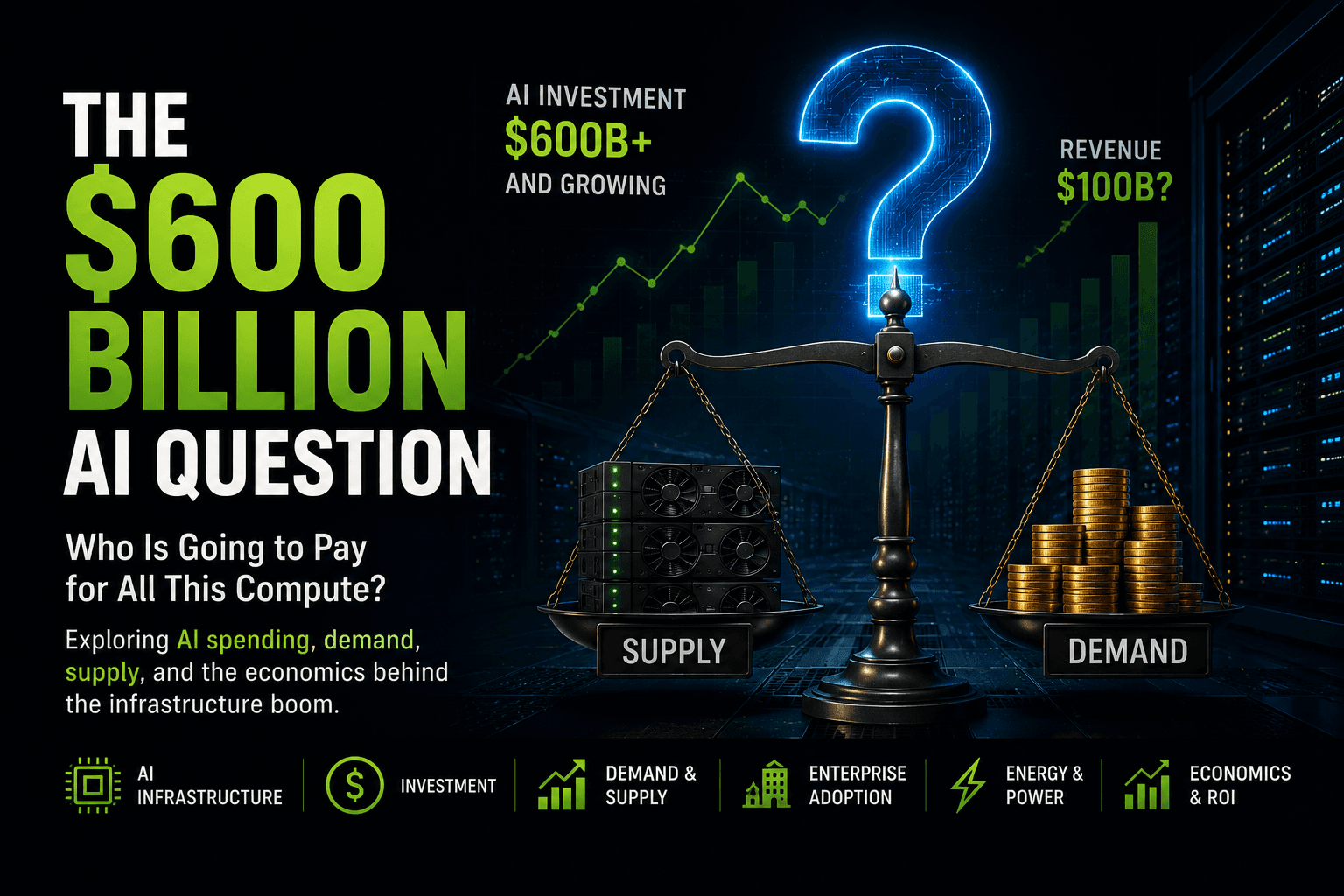
The $600 Billion AI Question: Who Is Going to Pay for All This Compute?
Artificial intelligence is no longer just a technology story.
It is now a financial story.
Billions of dollars are flowing into GPUs, data centers, networking equipment, electricity generation, cooling systems, chips, model training, AI startups and cloud infrastructure.
The numbers have become so large that it is easy to lose perspective.
And that is exactly why one question caught my attention:
Where is the demand that will ultimately justify all of this spending?
This isn't an argument that AI is a bubble.
It isn't an argument that AI is overhyped.
And it certainly isn't an argument that AI won't transform the economy.
My argument is much simpler:
Technology can create enormous value, but eventually the economics have to work.
No matter how impressive the technology is, supply eventually has to meet real demand.
And if the supply of AI infrastructure grows dramatically faster than the demand for the products and services running on that infrastructure, I think investors, companies and developers should start paying attention.
The origin of the $600 billion AI question
In June 2024, David Cahn of Sequoia Capital published an article titled "AI's $600B Question."
It was an update to his earlier 2023 analysis, "AI's $200B Question."
The central question was straightforward:
Where is all the revenue going to come from?
Cahn argued that the enormous infrastructure buildout implied by AI would require a corresponding amount of economic value to eventually flow through the ecosystem.
Sequoia's 2024 analysis estimated that the AI infrastructure ecosystem would need substantially more revenue to justify the scale of investment being made.
The important part of the argument wasn't the exact $600 billion number.
The important part was the relationship between infrastructure investment and revenue.
That distinction matters.
The "$600 billion" figure is often repeated online as though AI has a literal $600 billion hole in its balance sheet.
That isn't what the original argument means.
It is better understood as a question about the amount of economic value that must eventually be generated to justify the infrastructure being built.
Source: David Cahn, Sequoia Capital, AI's $600B Question, June 2024.
JPMorgan took the question seriously
JPMorgan's own analysis brought the argument into the financial world.
In its 2024 discussion of the AI investment boom, JPMorgan referenced Sequoia's analysis and described a roughly $600 billion data-center spending figure against approximately $100 billion in current revenue, creating a roughly $500 billion revenue gap under that framework.
That is a very different statement from saying:
"AI is missing $500 billion."
It means that if the infrastructure investment continues at that scale, the ecosystem needs considerably more monetization to make the economics attractive.
JPMorgan also highlighted another important problem.
At that stage, spending was heavily concentrated on training and infrastructure, while spending associated with actual inference and end-user applications was much smaller.
In other words:
We were building the factories faster than we were building the businesses that use the factories.
That is the part of this story I find particularly interesting.
Source: J.P. Morgan Private Bank, A severe case of COVIDIA: prognosis for an AI-driven US economy, September 2024.
But the numbers have changed
This is where the story gets interesting.
If someone reads the original "$600B question" and assumes that the same numbers still describe the AI market today, they are missing the evolution of the industry.
JPMorgan's 2025 Eye on the Market analysis estimated that hyperscalers could need approximately $400 billion of additional revenue to earn their traditional gross margins on roughly $250 billion of annual data-center spending.
That is already a different calculation from the original 2024 framing.
And in 2026, the scale has become even larger.
JPMorgan reported in February 2026 that four major technology companies had announced more than $600 billion of capital expenditures for 2026, approximately 70% above the previous year's level.
So the question didn't disappear.
It evolved.
The amount of capital being deployed became even larger.
Source: J.P. Morgan Asset Management, Eye on the Market Outlook 2025: The Alchemists.
Source: J.P. Morgan Private Bank, Tech Turbulence: AI disruption hits, February 2026.
This is where I think finance and technology collide
As someone interested in both technology and business, this is probably the most fascinating part of the AI boom.
Technologists naturally think about:
- model performance
- context windows
- reasoning
- agents
- inference
- GPUs
- training
- benchmarks
- latency
- token costs
Investors think about:
- revenue
- margins
- cash flow
- return on invested capital
- capital expenditure
- utilization
- pricing
- demand
- growth
Both groups are looking at the same machine from completely different directions.
And I think you need both perspectives to understand what is happening.
A technically incredible model can still be a terrible business.
And a company with an incredible business model can still fail if the underlying technology doesn't work.
AI sits directly in the middle.
Technology can create supply before demand exists
This isn't unique to AI.
Throughout economic history, industries have built infrastructure in anticipation of future demand.
Sometimes that demand arrives.
Sometimes it doesn't.
Sometimes the infrastructure becomes useful for an entirely different purpose than originally expected.
That is why I don't think the right question is:
"Is AI a bubble?"
That question is too simplistic.
The better question is:
"Is the demand for AI growing quickly enough to economically justify the supply of AI infrastructure being built?"
That is a much harder question.
And it is one that cannot be answered by looking at model benchmarks alone.
Demand is the ultimate truth
This is probably the biggest lesson I take from the entire discussion.
You can have:
- the world's best GPU
- the world's largest data center
- the world's most advanced AI model
- billions of dollars of venture funding
- the biggest technology companies on Earth
- extraordinary AI demonstrations
But eventually somebody has to pay for the output.
That's demand.
If an AI system costs $1 billion to build and generates $2 billion of economic value, that's potentially a fantastic investment.
If it costs $1 billion and generates $100 million of value, the technology might still be impressive, but the economics are terrible.
The technology doesn't get to vote on the economics.
Customers do.
And right now, demand is real
This is where I don't agree with the extreme "AI is all hype" argument.
There is clearly real demand.
Organizations are deploying AI.
Consumers are using AI products.
Developers are integrating AI into software.
Companies are building AI agents.
Cloud providers are expanding capacity.
And the infrastructure ecosystem continues to grow.
McKinsey's 2025 State of AI survey found that almost all respondents reported that their organizations were using AI, while 62% said their organizations were at least experimenting with AI agents.
But there is an important second half to that story.
McKinsey also found that nearly two-thirds of organizations had not yet begun scaling AI across the enterprise.
And only 39% reported an EBIT impact at the enterprise level.
That tells me something important.
AI adoption is real.
But enterprise-wide monetization is still developing.
Source: McKinsey & Company, The State of AI: Global Survey 2025, November 2025.
This is the part that worries me
If companies are spending hundreds of billions of dollars building infrastructure, I want to see demand growing at a rate that eventually supports that infrastructure.
Not just:
"People are trying AI."
But:
"People are paying for AI."
And not just:
"Companies have AI pilots."
But:
"AI is producing enough measurable economic value that companies are willing to expand those pilots into production."
There is a massive difference.
A free trial is demand.
A paid subscription is stronger demand.
A business restructuring around an AI product because the ROI is undeniable is an entirely different level of demand.
That is the progression I would watch.
The AI spending numbers are enormous
Gartner forecasts that worldwide AI spending will reach approximately $2.59 trillion in 2026, up 47% year over year.
More than 45% of that spending is expected to come from AI infrastructure, according to Gartner.
That is an extraordinary amount of capital.
And it tells us something important:
The supply side of the AI economy is moving incredibly fast.
Companies aren't waiting for demand to become obvious.
They are building capacity in anticipation of demand.
That could be incredibly smart.
Or it could create overcapacity.
The answer will depend on what happens next.
Source: Gartner, Forecasts Worldwide AI Spending to Grow 47% in 2026, May 2026.
The infrastructure problem is bigger than GPUs
One of the things I think gets overlooked in AI discussions is that AI infrastructure isn't simply:
GPUs = AI.
You need:
- electricity
- transmission
- data centers
- cooling
- networking
- transformers
- construction
- land
- skilled workers
- chips
- memory
- storage
- software
- cloud infrastructure
The International Energy Agency estimates that global data-center electricity consumption could reach approximately 945 TWh by 2030, roughly doubling from current levels.
AI-focused accelerated servers are expected to grow even faster.
That means AI isn't just creating demand for semiconductors.
It is creating demand for energy and physical infrastructure.
Source: International Energy Agency, Energy and AI.
And now supply itself is becoming a constraint
This creates an interesting paradox.
We're worried about potentially building too much AI infrastructure.
At the same time, we're struggling to build enough infrastructure quickly enough.
The IEA has identified bottlenecks involving:
- electricity grids
- transformers
- gas turbines
- advanced chips
- IT components
- grid connections
- permitting
- skilled labor
So the AI economy has two completely different risks.
Risk #1: Underbuilding
We don't build enough infrastructure.
AI demand exceeds available compute and electricity.
Prices remain high and growth is constrained.
Risk #2: Overbuilding
We build enormous amounts of infrastructure expecting future AI demand.
The demand arrives more slowly than expected.
Utilization falls.
Returns deteriorate.
Capital gets trapped in infrastructure that isn't producing enough economic value.
Both scenarios are possible.
And that's why I don't think "AI infrastructure spending" automatically means "AI revenue growth."
Source: International Energy Agency, Key Questions on Energy and AI.
Supply and demand eventually wins
This is where my perspective becomes much more economic than technological.
Markets can ignore fundamentals for a surprisingly long time.
Technology can generate enormous excitement.
Investors can price in future possibilities.
Companies can spend aggressively because their competitors are spending aggressively.
But eventually:
Supply meets demand.
If demand is stronger than supply, infrastructure gets utilized.
Prices remain healthy.
Companies have an incentive to build more.
Capital keeps flowing in.
If supply grows faster than demand, the opposite happens.
Prices fall.
Margins compress.
Utilization declines.
Companies slow investment.
Some infrastructure becomes obsolete.
Capital moves elsewhere.
This isn't an anti-AI argument.
It's simply economics.
The bullish case
There is a very strong bullish scenario for AI.
Imagine that AI agents become dramatically more capable over the next few years.
Instead of asking an AI model a question occasionally, companies start assigning AI systems entire workflows.
A software company might have agents handling:
- customer support
- testing
- documentation
- sales
- analytics
- coding
- monitoring
- security
- research
A bank might automate huge portions of its back office.
A pharmaceutical company might use AI throughout drug discovery.
A manufacturing company might integrate AI into design and operations.
If this happens at scale, today's infrastructure spending could look completely reasonable in hindsight.
The amount of compute required could be far greater than today's workloads.
In that world, the infrastructure being built today isn't excess supply.
It is preparation.
The bearish case
But there is another possibility.
AI capabilities continue improving, but businesses discover that many applications simply aren't economically valuable enough.
Companies might experiment with AI extensively but deploy only a small number of systems into production.
AI could become extremely useful without becoming extremely profitable for every company building infrastructure.
Another possibility is that model efficiency improves dramatically.
If models become much cheaper to run, the amount of compute required for a particular task could fall.
That sounds like a problem for infrastructure companies.
But it can also stimulate demand because cheaper intelligence creates entirely new use cases.
This is one of the most interesting contradictions in AI.
Efficiency can reduce compute required per task while increasing total compute demand by making more tasks economically viable.
The IEA has observed a version of this dynamic: energy consumption per AI task is declining rapidly, while increasing adoption and more energy-intensive applications are pushing overall AI-related electricity demand higher.
Source: International Energy Agency, Key Questions on Energy and AI.
The software problem
There is another risk that I think developers should pay attention to.
AI isn't just disrupting traditional industries.
It is increasingly disrupting software itself.
JPMorgan's 2026 analysis highlighted how new AI tools capable of coding and automating complex tasks have put pressure on traditional software companies.
That creates an unusual situation.
The companies building AI infrastructure may be betting that AI creates enormous new software and automation markets.
But AI can simultaneously reduce the value of some existing software products.
So the economic value doesn't necessarily disappear.
It can move.
That means the winners of the AI era may not look exactly like the winners of the previous software era.
Source: J.P. Morgan Private Bank, Tech Turbulence: AI disruption hits, February 2026.
The "picks and shovels" argument
One popular way of thinking about technological booms is:
Don't sell the gold. Sell the shovels.
There is some logic behind this.
During an infrastructure buildout, companies providing essential inputs can benefit regardless of which application eventually wins.
For AI, that can include:
- GPUs
- networking
- memory
- power equipment
- data centers
- cooling
- electricity
- cloud infrastructure
But even the picks-and-shovels companies aren't immune to demand risk.
If gold miners stop mining, shovel demand eventually falls.
The same principle applies to AI.
Infrastructure demand ultimately depends on workloads.
The financial system is now becoming part of the AI story
Something else has changed.
AI infrastructure is becoming too capital intensive to think about purely as a technology investment.
The IEA notes that data-center investments are becoming large enough that capital markets will play an increasingly important role in financing their expansion.
That means AI is becoming intertwined with:
technology + energy + finance + infrastructure.
And I think that's one of the most important developments of the entire AI boom.
The AI industry is no longer just about engineers building models.
It is becoming an enormous capital-allocation problem.
Where should trillions of dollars go?
Who should finance it?
Who owns the infrastructure?
Who gets the returns?
Who absorbs the losses if demand doesn't materialize?
Those are financial questions.
What would convince me that the AI boom is economically healthy?
I wouldn't look at one number.
I'd watch several.
1. AI revenue
Is revenue generated by AI applications growing quickly enough?
2. Enterprise ROI
Are companies actually making or saving enough money from AI to justify expanding their spending?
3. Inference demand
Is real-world usage growing faster than training infrastructure?
4. Infrastructure utilization
Are data centers being used heavily?
5. Pricing
Can AI providers maintain healthy pricing, or is competition forcing prices toward zero?
6. Cash flow
Are AI companies eventually converting growth into cash?
7. Capital efficiency
How much revenue and profit is being generated per dollar of infrastructure investment?
8. New use cases
Are new AI applications continually expanding the total addressable market?
Those metrics tell me much more than whether the newest model scored 2% higher on a benchmark.
What would make me nervous?
The opposite pattern.
Imagine:
AI infrastructure spending keeps accelerating.
But:
AI revenue growth slows.
Enterprise adoption remains stuck in pilots.
AI prices collapse.
Data-center utilization falls.
Companies continue spending primarily because competitors are spending.
And investors keep valuing companies based on future AI revenue rather than actual economics.
That would concern me.
Not because AI suddenly stops working.
But because the supply of infrastructure would be running ahead of the demand for economic output.
That is the real risk I see.
I don't think the answer is "AI is a bubble"
Personally, I think the phrase "AI bubble" is too simplistic.
There can simultaneously be:
- incredible technology
- real demand
- enormous economic value
- irrational valuations
- excessive spending
- legitimate infrastructure shortages
- future overcapacity
All of those things can exist at the same time.
The internet was transformative.
That didn't mean every internet company was a good investment.
Railroads transformed transportation.
That didn't mean every railroad built during the boom generated attractive returns.
The same principle can apply to AI.
A technology can change the world while investors still lose money building it.
And this is where I think developers should pay attention
For me, this isn't just an investor question.
It's a developer question.
If billions of dollars are being spent building AI infrastructure, somebody needs to create the applications that make that infrastructure valuable.
That's where I see the biggest opportunity.
Not necessarily:
"Build another giant language model."
But:
"Build something people actually need."
AI-powered developer tools.
AI-native software.
Vertical AI.
Agents.
Education.
Healthcare.
Finance.
Cybersecurity.
Automation.
Scientific research.
The next generation of software products may be built around AI from day one.
And developers are going to be the people building them.
The biggest AI opportunity might be on the demand side
This is probably my biggest takeaway from the entire $600 billion discussion.
Everyone is talking about increasing AI supply.
More GPUs.
More data centers.
More models.
More compute.
More power.
But eventually, demand has to catch up.
That means the biggest opportunity may not be another company building infrastructure.
It may be the companies creating products that make millions of people and businesses say:
"I need this."
Because once a product creates enough value, the infrastructure underneath it becomes economically justified.
That's how technology compounds.
Useful products create demand.
Demand creates revenue.
Revenue justifies investment.
Investment creates more infrastructure.
More infrastructure makes technology cheaper and more capable.
And cheaper, more capable technology creates new demand.
That's the virtuous cycle we're all betting on.
My conclusion
I am extremely optimistic about AI.
But optimism doesn't mean ignoring economics.
The $600 billion question isn't really:
"Will AI work?"
I think AI will work.
The more important question is:
"Will the economic value created by AI grow fast enough to justify the enormous amount of capital being invested into the infrastructure required to build it?"
I don't know the answer yet.
And I don't think anyone honestly does.
The bullish case is enormous.
AI could fundamentally change software, healthcare, finance, science, manufacturing and almost every knowledge-based industry.
But the risks are also real.
If infrastructure supply grows dramatically faster than actual demand, we could see periods of overcapacity, falling margins and painful capital destruction.
That's not necessarily the end of AI.
It could simply be the market correcting itself.
And that's why I keep coming back to one principle:
Ignore the hype for a moment. Watch demand and supply.
Because regardless of how revolutionary the technology is, economics eventually gets the final vote.
What I will be watching
Over the next few years, I will be watching five things:
AI revenue.
Enterprise ROI.
Infrastructure utilization.
Inference demand.
And capital efficiency.
If all five continue moving in the right direction, the enormous AI infrastructure buildout could look cheap in hindsight.
If they don't, the industry may have built far more capacity than the market actually needed.
Either way, I think we're watching one of the most important technology-and-finance experiments of our generation.
And we're still very early.
Sources & Further Reading
Sequoia Capital
David Cahn — "AI's $600B Question" (June 2024)
The original analysis behind the $600B thesis and the follow-up series examining AI infrastructure economics.
J.P. Morgan Private Bank
"A severe case of COVIDIA: prognosis for an AI-driven US economy" (September 2024)
An analysis of AI infrastructure spending, revenue requirements, adoption and the economic questions surrounding the AI investment boom.
J.P. Morgan Asset Management
"Eye on the Market Outlook 2025: The Alchemists"
Analysis of AI capital spending and the implied revenue requirements for hyperscalers.
J.P. Morgan Private Bank
"Tech Turbulence: AI disruption hits" (February 2026)
Analysis of the enormous 2026 AI capex plans and the interaction between AI infrastructure, software disruption and financial markets.
Gartner
"Forecasts Worldwide AI Spending to Grow 47% in 2026" (May 2026)
AI spending forecasts and the growing importance of AI infrastructure.
McKinsey & Company
"The State of AI: Global Survey 2025" (November 2025)
Enterprise AI adoption, AI agents, scaling and reported business impact.
International Energy Agency
"Energy and AI"
Analysis of data-center electricity consumption, AI infrastructure and the energy constraints associated with AI growth.
A note on this analysis
This article discusses publicly available research and market estimates and represents my own interpretation of the information.
The figures cited above come from different methodologies, time periods and definitions. They should therefore not be treated as directly comparable measurements of a single "AI revenue gap."
The purpose of the analysis is to understand the underlying relationship between AI investment, infrastructure supply, economic demand and monetization, rather than to predict the exact future size of the AI market.